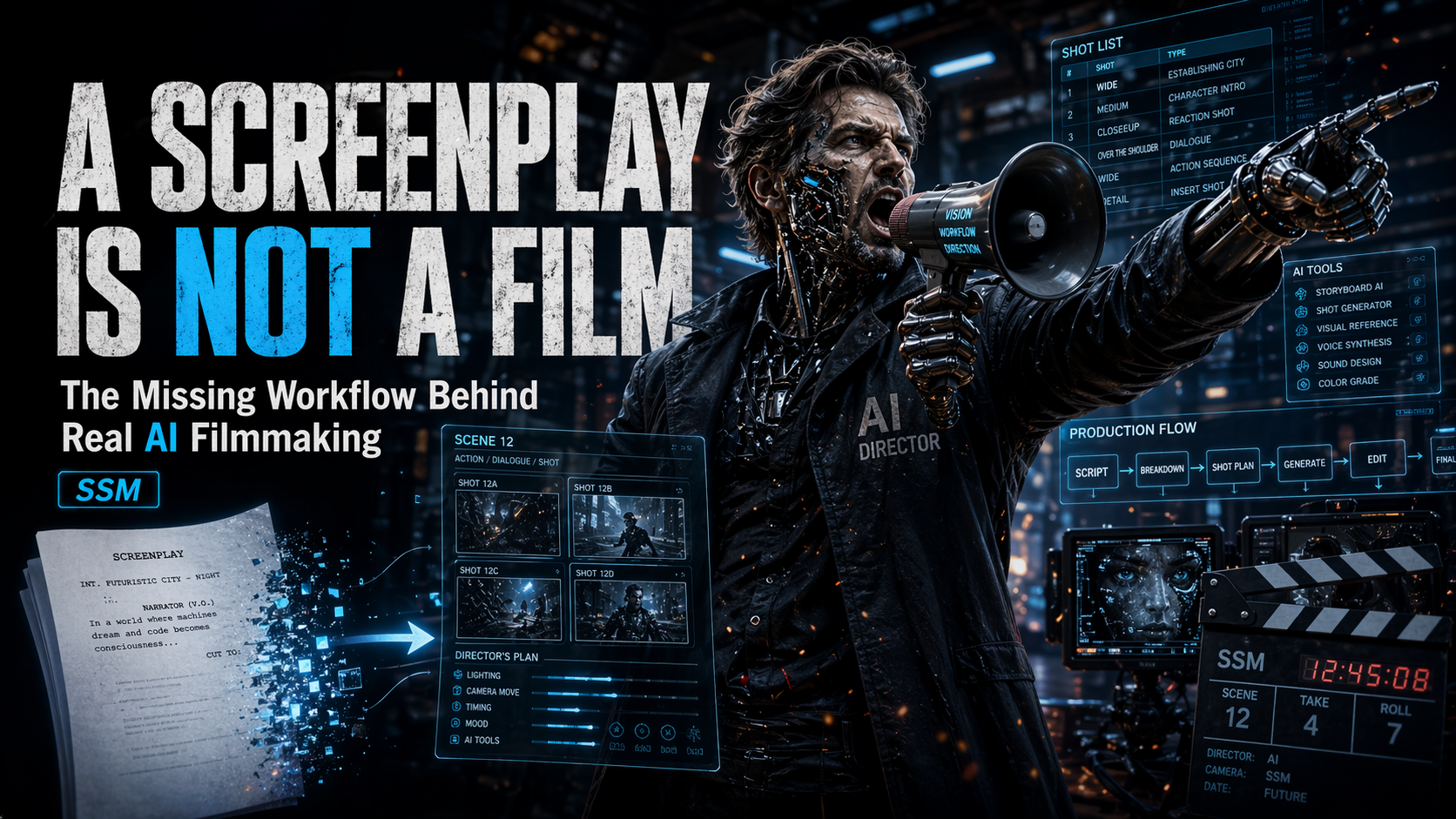
This article is different from any version you’ll find in Japan. I’m putting this out there because somewhere in the world, there are individuals searching for a way to actually film a movie using AI. For those rare souls, this is a permanent reference—a structural verbalization of a craft that exists nowhere else.
The Great Misconception: “I Have a Script, So I Can Make a Movie”
We have to start here. Most people think: “If I have a script, filming with AI is easy.”
Wrong. Dead wrong. If that statement made you flinch, you’re either honest or you’ve actually sat in the director’s chair.
Think about a feature film, or even a single 22-minute anime episode. There’s a Director. Do you think they just sit there and yell “Cut!”? Do you see them as just a manager? Some might think that with AI, the “directing” is the AI’s job.
The answer is no.
The Real Work of a Director: Reconstructing Story into Vision
A story and a visual are two entirely different beasts. You must take the story into your mind, break it down, and rebuild it into what I call a “Visual Narrative.” You have to restructure the rhythm, the tension, and the soul of the story specifically for the screen.
You break the story into Scenes, then you break those scenes into Shots. You build the script around these shots, and then you film—not in chronological order, but in the order that makes sense for the production.
When I say this isn’t the AI’s job, it’s because AI—as powerful as it is—is designed to be a “universal provider.” It isn’t built to understand the specific artistic intent of a shot unless you force it to.
The Inverse Calculation: AI as your Cinematographer
If you want to film a movie with AI, you must apply professional cinematography techniques. You are the Director. The AI is your Cinematographer.
To make this work, you have to do the work of a Director. You must also master the AI. And to master the AI, you need IT knowledge—you must understand the limitations of the environment and the structural behaviors dictated by the code.
The difficulty of filming a “real” movie with AI lies in this intersection of artistic vision and technical calculation. AI won’t just “act” because you told it to. It requires a specific language and an understanding of its inherent IT-related constraints.
The Master Prompt: A Practical Masterclass
AI dictates its output based on your prompt. To give you a real example, here is the structure of a perfect prompt—rebuild this into your own workflow.
[Global Overview]
This is a heartwarming story of an elderly man looking back on his past. He recalls a mysterious tale told to him by a ryokan landlady about fairies living in the Kusatsu hot springs—an old legend that he eventually experienced for himself.
[The Timeline: Scene Breakdown]
- Scene 1 (10s / Present): An elderly man tends to the garden of a Kusatsu hot spring inn.
- Scene 2 (30s / Flashback - Age 5): The boy is taken to the inn by his grandfather and hears the fairy legend from the old landlady.
- Scene 3 (90s / Flashback - Age 5): The boy tells a young girl his age about the Kusatsu fairies.
- Scene 4 (45s / Flashback - Age 20): The man has succeeded the gardening business; he learns the girl is leaving for Tokyo.
- Scene 5 (25s / Flashback - Age 20): The landlady tells him to ask the fairies for help; he hears a faint bell in the corner of the garden.
- Scene 6 (30s / Flashback - Age 20): He walks alone by the Yubatake at night, sees a tiny shadow in the steam, and prays for her return.
- Scene 7 (30s / Flashback - Late 20s): Years later, she returns to Kusatsu; they reunite and eventually marry.
- Scene 8 (45s / Flashback - Age 30): She gazes at a white flower by the stone lantern; later, their two children are born.
- Scene 9 (35s / Present): The elderly man tells the story to a local 5-year-old boy, whispering: “Only for those who believe.”
[The Current Shoot]
Scene 4 (45s / Flashback): The man learns she is leaving for Tokyo.
- Scene 4, Shot 1 (5s): Flashback. He is working as a gardener.
- Scene 4, Shot 2 (5s): Close up on him using the pruning shears inherited from his grandfather.
- Scene 4, Shot 3 (5s): He continues working near the stone lantern.
Ray, start filming from Scene 4, Shot 1.
Why This Prompt Controls the Machine
It looks long, doesn’t it? But it is incredibly condensed.
First, understand that this specific setup is only used while shooting Scene 4. Always keep the section labeled “[The Current Shoot]” perfectly aligned with what you are actually filming. The scene summary is already written in your overall timeline, so just copy it directly from there.
When you move to the next shot within that scene, you copy-paste the entire prompt and only change the final execution line.
Then, when it’s time to shoot the next scene entirely, rewrite the Shot breakdown to match the new scene, and update that final command line to point the camera to the new target.
As for maintaining character consistency, please refer to the videos and articles on this channel. I won’t go into detail here. Frankly, with this method, it’s easy no matter what AI you use.
This framework calculates for the “habits” of the AI’s algorithm. It fixes the AI’s understanding of what it is doing and why it is doing it. By specifying the time and keeping the keywords lean, you get almost 100% of the performance you intended.
I say “almost” because even in your own head, your vision is only “almost” fixed. A film is a sequence of outcomes. You are always searching for a better shot. Those who demand 100% mechanical accuracy have no talent for directing. You let the AI “think” within the boundaries you’ve set, you receive the result, and then you judge. Is this a good shot? That’s the only question. When you get the shot, that’s when you yell “CUT!”
The Commandments of AI Cinematography
- Scene to Shot: Always break your story down into scenes, then into individual shots.
- Read the Algorithm: Understand the AI’s quirks, for example, be careful with too many subjects.
- Keyword Minimalism: Do not write “fluff.” Keywords are everything.
- Abandon Camera/Background Over-spec: Do you think you can describe a 3D world in words better than the AI can generate it? Look at the macro. Be a Director, not a manual.
- Time-Boxing: Specify the duration of the “acting” within the shot.
- The Zero-Reset Rule: Assume the AI forgets everything. Every prompt must re-stamp the entire global context into its memory.
- Respect the Token Limit: Keep it tight enough for the API to process without losing the “soul.”
Epilogue: The Reality of the Era
The world is drowning in smartphone culture—people want AI to make things “easy.” They want light work. They convince themselves that “high-tier” film is only for humans because nobody has shown them what AI can truly do yet.
But the truth is right here.
You are the one who makes it real. I am waiting for your masterpiece. Filming a real movie with AI—it’s a beautiful dream, isn’t it? Let’s make it happen.